
FinStack by Takamul Software

From the boat to the balance sheet — one system.

FinStack connects purchasing, landings, processing, inventory, sales and accounting so you always know your true cost per kilo and your real profit, today — not next month.
Book a live demo
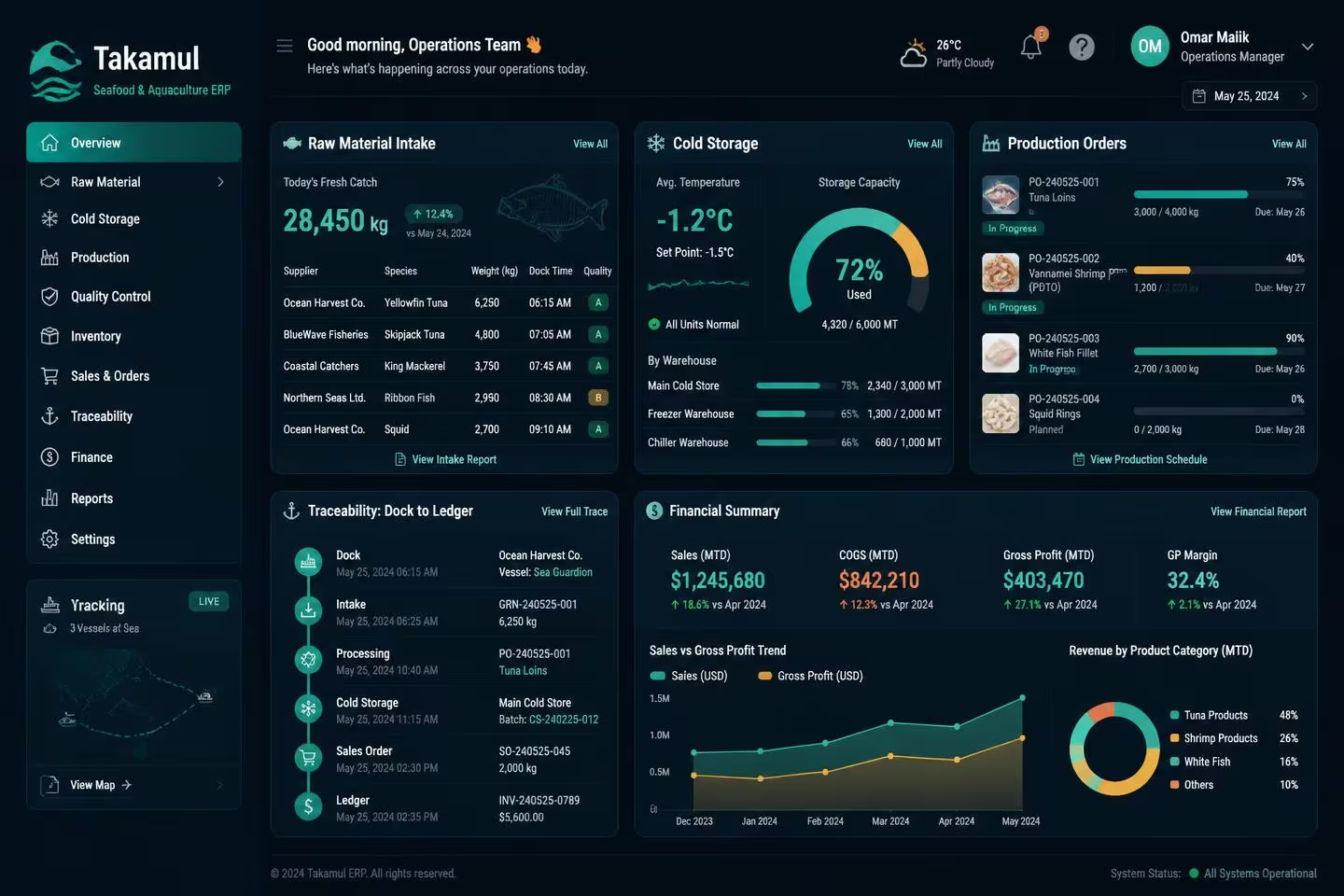
FinStack dashboard showing raw material intake, cold storage, and production traceability
The problem

You already have the data. You just can't trust it.

Most seafood and food factories run on disconnected tools: a weighing sheet at the landing bay, a WhatsApp thread for approvals, one spreadsheet for supplier balances, another for stock, and an accountant rebuilding all of it at month-end.

Nobody knows the real cost per kilo

Purchase price, freight, ice, labour and yield loss never meet in one number, so pricing is guesswork.

Two people, two answers

Operations says one stock figure, finance says another, and the argument takes a whole morning.

Stock ages quietly

By the time anyone notices a lot has been sitting too long, the value is already gone.

Approvals disappear

A purchase order gets verbally approved, then nobody can say who approved it or at what price.

Month-end takes weeks

Closing the books means re-keying the same transactions a third time.

Vendors and customers chase you

Statements are built by hand, so they arrive late and get disputed.

No trail

When a number changes, there is no record of who changed it, when, or from what.

How FinStack solves it

FinStack removes the re-keying, the reconciliation and the guesswork by capturing each fact once, at the moment it happens, and letting every other module use it.

Benefits by buyer

Every role gets the answer it needs

Owners, finance, operations — and any factory that buys raw material, transforms it and sells the output.

Factory owners and general managers

Run three factories from one screen.

  • Live profit visibility — revenue, stock value, receivables and payables update as your team works.
  • True cost per kilo — purchase cost, processing yield and overheads combine into a landed cost you can price against.
  • Control over spending — approval rules enforce who can commit money and at what value, before it leaves.
  • Multi-factory oversight — compare sites side by side, or restrict each manager to their own factory with one setting.

Finance and accounting managers

The ledger writes itself.

  • Automatic postings — invoices, payments, payroll, loans and processing costs generate balanced journal entries as they happen.
  • A faster close — trial balance, income statement and balance sheet are live views, not month-end projects.
  • Accurate multi-currency — daily rates are snapshotted onto each transaction, so history never drifts.
  • Audit-ready by default — every create, change and approval is logged with user, timestamp and before/after values.

Operations and QA managers

Full traceability, from the landing bay to the customer's door.

  • Capture at source — weigh tickets and lots recorded at the bay with species, grade, vessel, catch area and FAO zone.
  • Lot-level traceability — trace any finished carton back to the exact landing, vendor and vessel in seconds.
  • Yield you can manage — processing orders record input and output per stage, so loss becomes a number you can act on.
  • Age-aware stock — every lot is classified fresh, aging or critical automatically.

Any food or manufacturing business

Not just seafood.

  • The engine underneath is generic: you buy raw material, transform it, and sell the output.
  • Species and grades become items and variants; landings become goods receipts.
  • Processing orders become production runs, with the same stage and yield tracking.
  • Traceability, costing, inventory, accounting and payroll all work exactly the same way.
Feature catalogue

Ten connected modules, one record of the truth

Purchase orders, weigh tickets, lot traceability, processing yields, multi-currency accounting, payroll and loans — in a single connected platform.

Procurement and vendors

  • Purchase orders raised, priced, approved and tracked, with remaining quantity calculated against receipts
  • Approval rules that decide which orders need a second signature and from whom
  • Vendor master with contacts, payment terms, banking details and documents
  • Monthly vendor performance scoring on delivery and quality
  • Purchase invoices with two-stage approval — accountant, then general manager
  • Payments allocated across specific invoices, with over-allocation blocked
  • A vendor portal showing each vendor their own orders, deliveries and balances
  • Vendor statements generated on demand, with credit notes traced to the invoices they offset

Receiving and quality

  • Receiving notes recording what physically arrived against the order, with variances visible immediately
  • Weigh tickets captured at the landing bay, on a phone if needed
  • Every intake becomes a traceable lot with species, grade, vendor, vessel, catch area and FAO zone
  • Inspection notes and photographs attached to the lot they belong to
  • A traceability view that walks a lot forward to dispatch or backward to its source
  • The landing screen refreshes in real time as tickets are recorded

Inventory

  • Lot-level stock by quantity and value, item, grade and location
  • Fresh, aging and critical bands calculated automatically from landing date
  • A complete movement trail for every lot
  • Controlled adjustments, each with a reason and an automatic accounting entry
  • Per-item reorder levels with low-stock alerts
  • Multi-location stock separated by factory, chiller and store
  • Batch updates that correct many weights at once as a single atomic commit

Processing

  • Processing orders with a controlled lifecycle from draft to completed, with approval gates
  • Your own processing stages, each recording input and output
  • Presentations and grades mapping raw species into finished products
  • Yield tracked per species and per stage, trended over time
  • Configurable cost formulas that turn processing activity into costed output

Sales and dispatch

  • Quotations that convert into orders without re-keying
  • Dispatch notes recording what left and from which lots
  • Sales invoices with tax codes, multi-currency and status tracking
  • Credit notes linked to the original invoice and traced through the statement
  • Recurring invoice templates that bill on schedule
  • Payments captured and allocated across invoices
  • Customer statements generated instantly, with a secure shareable link
  • Margin reporting by customer, item and period

Finance and accounting

  • A full hierarchical chart of accounts you control
  • Manual journal entries with enforced balancing
  • A general ledger where every posting drills back to the transaction that created it
  • Live trial balance, income statement and balance sheet
  • Aged payables and receivables with drill-down to the documents
  • Expenses with categories, attachments and approval
  • Budgets set by account and tracked against actuals
  • Multi-currency with daily rates, automatic fetching and a rate snapshot on each transaction
  • Central tax codes applied consistently across documents
  • Cost centres by factory, so per-site profitability is real

Payroll and HR

  • Employee records with personal details, contracts and mandatory documents
  • Salary structures defined once and applied per employee
  • Payroll batches run through draft, approved, posted and paid
  • Approved payroll writes its own journal entries
  • Employee cost split across factories by percentage
  • Attendance tracking and leave requests
  • Labour cost reporting by factory and period

Loans and advances

  • Cash advances or payments made on a vendor's behalf against a purchase order
  • Declining-balance amortisation with a clear repayment plan
  • Repayments recorded against the schedule, with balances updated automatically
  • Loan movements and monthly interest posted without manual entries
  • Loan aging, repayment trends and default-risk views

Reporting and analytics

  • An executive dashboard with revenue, stock, receivables and today's tasks
  • Seven-day and six-month KPI trend charts
  • Operational reports: purchases, sales, yields, cycle time, inventory, AR/AP aging
  • Procurement analytics for spend, vendor concentration and price movement
  • Statement analytics showing customer balance behaviour over time
  • Scheduled reports emailed automatically on the schedule you set
  • Batched exports for any list in the system

Platform

  • Granular role-based access — admin, general manager, accountant, QA, inventory, procurement and more
  • Factory-level isolation enforced at the database layer
  • An audit log showing who changed what, when, with a before/after comparison
  • In-app notifications for approvals, exceptions and assignments
  • Internal chat tied to the work being discussed
  • A file manager with secure time-limited links
  • Session tracking for who is online and historical activity
  • Full bilingual Arabic and English interface, switchable per user
  • Installs on a phone like a native app and works on desktop
  • An email centre for outbound documents with a delivery dashboard
Time saved

Where the hours actually go back.

Estimates based on typical manual workflows in a mid-sized factory of roughly 40 to 120 staff. Treat them as a model to test against your own numbers, not a guarantee.

Daily taskTypical manual wayWith FinStackEstimated saving
Raise and approve a purchase orderWrite it, email it, chase the approval, re-type it — 20 to 30 minRaise it, rules route the approval, receipt links itself — 3 to 5 min~20 min per order
Record a landingPaper weigh sheet, then evening data entry — 45 to 60 minTickets captured at the bay on a phone, lot created instantly — 10 min~40 min per landing
Price a supplier invoiceMatch against orders and receipts by hand — 25 minMatched against the order and receipt automatically — 5 min~20 min per invoice
Chase an approvalPhone calls and follow-ups — 15 min spread over a dayNotification with one-click approve — under 1 min~14 min per approval
Build a customer statementAssemble from invoices, payments and credit notes — 30 to 45 minGenerated instantly and shareable by link — 1 min~35 min per statement
Reconcile stockCompare sheets against a physical count — half a day, weeklyLive lot-level balances, count only to confirm — 1 hour~3 hours per week
Run payrollCollect attendance, calculate, check, post — 1 to 2 days per periodBatch run, review, approve, posts itself — 2 to 3 hours~1 day per period
Close the monthRe-key and reconcile across systems — 5 to 10 working daysStatements already live, review and adjust — 1 to 2 days~5 days per month
Produce a management reportExport, paste, chart, format — 2 to 4 hoursOpen the dashboard, or receive it by scheduled email — 0 min~3 hours per report
  • Cut administrative data entry by an estimated 50 to 70 percent.
  • Shorten month-end close from weeks to days.
  • Move from monthly to daily cost visibility.
  • Reduce operations-versus-finance disputes to near zero.

Estimated typical results. Actual outcomes depend on volume, team size and adoption.

Measurable results

Numbers you can hold us to.

Modelled estimates for a seafood or food factory of roughly 40 to 120 staff processing daily landings, derived from the task timings above — not from a single customer.

~30 hours

returned to your team every week

Across procurement, receiving, invoicing and reporting.

80% faster

month-end close

From 5 to 10 working days down to 1 to 2 days of review.

50 to 70%

less administrative data entry

Each fact is captured once and reused everywhere.

Under 60 seconds

to produce a customer statement

Assembled live and shareable by secure link.

Seconds, not hours

to trace a lot end to end

Landing to grade to processing run to dispatch, both directions.

~90% faster

payroll run

From 1 to 2 days per period to 2 to 3 hours, posted automatically.

Minutes, not days

approval turnaround

Rules route each request with one-click approve.

~3 hours weekly

saved on stock reconciliation

Live lot-level balances mean the count confirms rather than reconstructs.

Business outcomeManual baselineWith FinStackDelta
Time to close the month5 to 10 working days1 to 2 days~80% faster
Time to know true cost per kiloEnd of month, if at allSame day, per lot and per runMonthly to daily
Invoice matching disputesFrequent, resolved by re-checking paperOrder, receipt and invoice matched automaticallyNear zero
Time to answer "where did this fish come from?"Hours of file searchingSeconds, with the full chain shownHours to seconds
Stock accuracy between countsEstimated from sheets, drifts through the weekLive, lot level, adjustments loggedEstimate to live
Receivables visibilityA sheet someone updates weeklyLive ageing buckets, per customerWeekly to live
Approval turnaroundSame-day at best, often longerMinutesDays to minutes
Management reporting effort2 to 4 hours per report, manually builtDashboard, or delivered by scheduled email~3 hours to zero
Admin data entry volumeEvery fact re-typed 2 to 4 timesCaptured once50 to 70% reduction

Metrics the system measures for you

You don't have to take our word for the numbers. The system reports them.

  • Processing yield percentage — per run, species and grade, against target
  • Cost per kilo — landed, processed and fully loaded, per lot
  • Purchase price variance — ordered against invoiced, per vendor
  • Vendor health score — monthly delivery reliability and quality
  • Inventory ageing — fresh, aging and critical, by landing date
  • Receivable and payable ageing — live buckets with matching statements
  • Approval cycle time — how long each request waits, and with whom
  • Yield and weight variance — expected against received, flagged at the bay

Estimated typical results, modelled on standard manual workflows. Actual outcomes depend on volume, team size and adoption.

Return on investment

The maths, with our assumptions visible.

A worked example. Substitute your own numbers — every assumption is listed so you can check it.

Assumptions

  • 6 staff spend significant time on operational admin
  • Each saves 1.5 hours per working day
  • 22 working days per month

Recovered time

6 staff × 1.5 hours × 22 days = 198 hours per month of recovered capacity, redirected from re-keying to work that moves the business.

Error and leakage reduction

Duplicate payments, missed credit notes, unbilled dispatches and stock written off for ageing all cost margin. Removing that leakage adds directly to profit.

Decision speed

The hardest value to price and often the largest: pricing a customer with today's real cost instead of last month's estimate.

This is an illustrative model, not a quotation or a promise of results.

Why FinStack

Built for factories that buy, transform and sell

How FinStack compares with the three alternatives most factories weigh up.

Versus spreadsheets

Spreadsheets are free until they aren't: no permissions, no audit trail, no validation, no single version. FinStack keeps the flexibility you like — exports, custom reports, your own account structure — while making the underlying data one trustworthy record.

Versus generic accounting software

Standard accounting packages start at the invoice. They have no concept of a landing, a lot, a weigh ticket, a processing yield or a catch area — so you run a parallel operations spreadsheet anyway. FinStack covers both halves, so the accounting is a by-product of the operations.

Versus a large international ERP

Big ERP implementations are measured in years and hundreds of thousands, configured by consultants who have never stood in a landing bay. FinStack arrives already shaped for this industry, in Arabic and English, priced for a regional business.

Built here, for here

Arabic and English throughout. Built and supported in Oman by Takamul Software, with local currency, local terminology and support in your timezone.

Security and trust

Your data, properly protected.

Permissions, isolation and a complete history behind every number.

Role-based permissions

Every role gets exactly the access it needs. Finance cannot alter quality records; operations cannot open payroll.

Factory-level isolation

Users assigned to one site cannot read another site's data — enforced in the database, not just hidden in the interface.

Complete audit history

Every create, update, approval and rejection is recorded with user, timestamp and a before/after comparison. Rejections require a written reason.

Session controls

Idle sessions expire automatically with advance warning, and administrators can review session history.

Approval segregation

Sensitive workflows such as purchase invoices require two different people to complete.

Encrypted cloud hosting

Encrypted hosting with automatic daily backups, plus retention controls for messages and attachments so old data does not accumulate indefinitely.

Rollout and support

Live in weeks, not years.

A six-step rollout that ends with you trusting the numbers before you switch.

  1. Discovery

    We walk your process end to end — landing bay to ledger — and map it to the system.

  2. Setup

    Your factories, users, roles, species and grades, items, chart of accounts and opening balances are configured.

  3. Data migration

    Vendors, customers, stock and balances are brought across from your existing files.

  4. Training

    Role-based sessions in Arabic or English — operations staff learn only their screens.

  5. Parallel run

    Run alongside your current method for one cycle until you trust the numbers.

  6. Go live and support

    Ongoing support from the Takamul Software team after go-live, in Arabic and English.

FinStack pricing

Packaging for fish processing plants, aquaculture farms and seafood exporters.

Starter

From $339 / month

Billed annually or monthly

For one plant recording landings, purchases and cold-store stock accurately.

  • Up to 3 users
  • 1 plant / cold store
  • Landings and supplier purchases
  • Cold-store inventory by species and grade
  • Sales orders and invoicing
  • Bilingual Arabic / English UI
Request a quote
Recommended

Professional

From $829 / month

Billed annually or monthly

For processors and exporters that need yield, traceability and export paperwork.

  • Up to 15 users
  • 3 plants / cold stores
  • Processing batches and yield analysis
  • Full traceability, vessel to carton
  • Export and health certificate packs
  • Aquaculture ponds and feeding records
  • Priority support
Book a free demo

Enterprise

Custom pricing

Tailored to your operation

Vertically integrated groups running vessels, farms, plants and export desks together.

  • Unlimited users, plants and farms
  • Custom integrations and APIs
  • Weighbridge and scale hardware links
  • Executive dashboards and advanced analytics
  • Dedicated onboarding and training
  • SLA-backed support
Talk to sales

All plans include: real-time sync, bilingual Arabic/English UI, audit logs, role-based access and PWA mobile access. Annual billing saves two months.

Questions

FinStack — common questions

Languages, multi-factory, multi-currency, migration and approvals — answered for factory teams in Oman and the GCC.

Stop reconciling. Start deciding.

See FinStack running against your own process. A short, honest walkthrough — no obligation.

FinStack by Takamul Software — from the boat to the balance sheet.